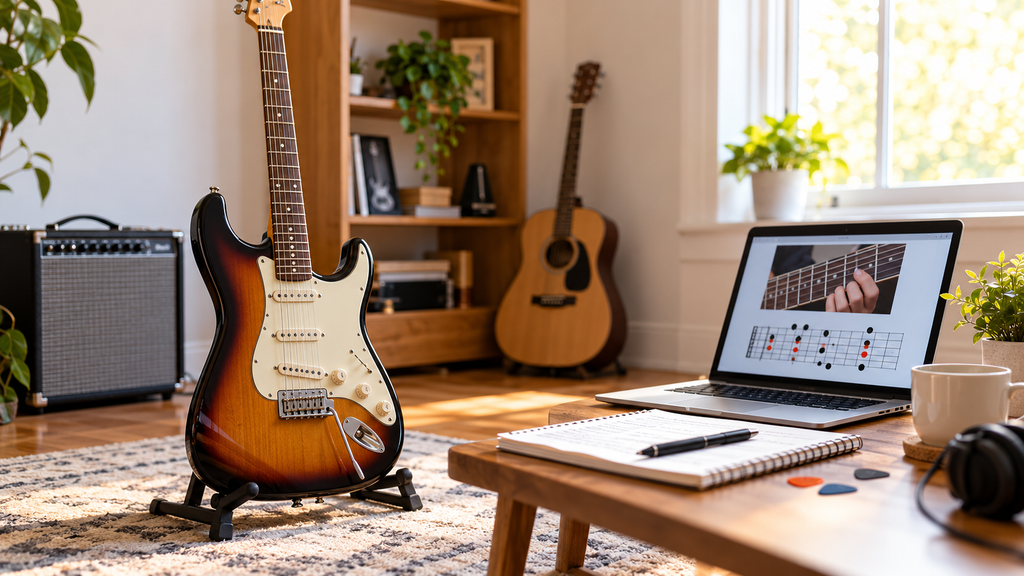
Learn guitar at your own pace with practical lessons, easy-to-follow fretboard diagrams, and exercises that help you turn scales into real music.
Whether you’re picking up a guitar for the first time or you’ve been playing chords for years and want to start soloing, Guitar Scale Guide helps you build your skills one step at a time.
You don’t need expensive equipment, complicated music theory, or hours of practice every day to begin improving.
What you need is a clear learning path, consistent practice, and an understanding of how guitar notes, scales, and patterns work together.
At Guitar Scale Guide, you’ll discover how to:
- Understand the notes on your guitar fretboard.
- Learn essential major, minor, and pentatonic scales.
- Practice guitar scales without feeling overwhelmed.
- Play simple blues licks and melodic guitar solos.
- Connect scale patterns across the fretboard.
- Improve your timing, picking technique, and musical expression.
- Develop an effective guitar practice routine at home.
New to guitar? Start with our Guitar Scales for Beginners guide and build your skills from the fundamentals.
Want a more structured way to master pentatonic guitar scales?
If you’re ready to move beyond memorizing scale shapes and begin developing your lead guitar skills, explore this dedicated pentatonic guitar training program.
Explore the Pentatonic Guitar Course →
Affiliate link: We may earn a commission if you purchase through this link, at no additional cost to you.
Start Learning Guitar at Home
Learning guitar at home gives you the flexibility to practice at your own speed. You can revisit difficult lessons, spend extra time on challenging finger positions, and gradually develop confidence.
However, learning without a teacher can become frustrating when you don’t know what to practice next.
That’s why we organize our lessons into a practical learning sequence.
Step 1: Understand Your Guitar Fretboard
Your guitar fretboard contains repeating note patterns that become easier to recognize with practice.
Instead of memorizing every note immediately, begin by understanding how strings, frets, and musical notes relate to each other.
Start with these lessons:
- Guitar Scales for Beginners
- How to Read Guitar Scale Diagrams
- How to Memorize Guitar Fretboard Notes
Once you understand basic fretboard navigation, scale patterns will begin to make more sense.
Step 2: Learn Your First Guitar Scales
A guitar scale is an organized collection of musical notes.
Scales provide the foundation for melodies, riffs, solos, and many improvisation techniques.
You don’t need to learn every scale immediately.
Begin with a small selection of useful patterns, especially the minor pentatonic scale.
Explore:
These lessons introduce essential note patterns and explain how to use them musically.
Step 3: Learn the Five Pentatonic Scale Positions
One of the most useful developments in your guitar playing is learning how familiar scale patterns connect across the neck.
The pentatonic scale contains five notes per octave, and guitarists commonly learn five interconnected fretboard positions.
Understanding these positions can help you move beyond playing in a single area of the fretboard.
Read our Five Pentatonic Scale Positions lesson.
You can also use our Pentatonic Scale Chart as a visual reference while practicing.
Step 4: Turn Guitar Scales Into Real Solos
Knowing a scale pattern is only the beginning.
Playing a memorable guitar solo involves rhythm, phrasing, note selection, and expression.
You don’t need to play fast to create a good solo.
Start by playing a few notes over a simple backing track. Experiment with pauses, repeated phrases, and changes in rhythm.
As your confidence improves, introduce techniques such as string bending, vibrato, slides, and hammer-ons.
Continue with:
The goal is to make your playing sound musical rather than simply moving through a memorized pattern.
Explore Our Guitar Learning Guides
Guitar Scales for Beginners
If you’re just starting, learning a few basic scale patterns can improve finger coordination and help you understand the guitar neck.
Our beginner lessons explain common scale terminology, how to read diagrams, and how to practice accurately.
Explore Guitar Scales for Beginners →
Pentatonic Guitar Scales
Pentatonic scales are widely used in blues, rock, country, pop, and other styles.
Their relatively simple structure makes them approachable for beginners while remaining valuable for experienced players.
Learn the major and minor pentatonic patterns, discover how their positions connect, and practice using them in musical phrases.
Explore the Pentatonic Scale Guide →
Guitar Scale Charts and Fretboard Patterns
Visual scale diagrams make it easier to identify note locations and understand repeating patterns.
Our scale charts are designed to help you recognize root notes, understand finger positions, and practice different fretboard areas.
View Pentatonic Scale Charts →
Blues Guitar and Improvisation
Blues guitar offers an accessible introduction to expressive lead playing.
Discover how pentatonic and blues scales work with common chord progressions, then practice simple licks, bends, and rhythmic phrases.
Learn the Blues Scale on Guitar →
Guitar Practice and Skill Development
Progress comes from consistent, focused practice rather than simply repeating exercises for long periods.
Learn how to structure your practice sessions, use a metronome, review difficult passages, and gradually develop speed and accuracy.
Learn How to Practice Guitar Scales →
Why Learn Pentatonic Scales First?
Pentatonic scales are among the most practical tools for guitarists interested in lead playing.
The minor pentatonic scale is especially common in rock and blues, while the major pentatonic scale is frequently heard in country, blues, pop, and melodic lead guitar.
Here are five reasons to start with pentatonic scales.
1. Fewer notes to learn
A pentatonic scale uses five different notes per octave, compared with seven in a typical major scale.
2. Recognizable fretboard patterns
The commonly taught positions form repeatable shapes that can be moved to different keys.
3. Useful for improvisation
Pentatonic scales provide a manageable collection of notes for creating melodies and solos over suitable chord progressions.
4. Applicable to many musical styles
The same basic scale concepts appear in blues, rock, country, and contemporary guitar music.
5. A foundation for advanced playing
After learning pentatonic scales, you can explore blues notes, chord tones, modes, and more sophisticated improvisation techniques.
Remember that learning a scale does not automatically make every note sound good over every chord. Timing, harmony, and musical phrasing still matter.
Ready to Connect Your Pentatonic Patterns and Improve Your Solos?
If you already know a few scale shapes but struggle to use them in actual music, a structured pentatonic guitar course may help you organize your practice and build confidence.
Discover the Pentatonic Guitar Training Program →
Affiliate link: We may earn a commission from qualifying purchases.
Learn Guitar Scales With a Structured Course
Free guitar lessons can be an excellent starting point. However, some learners prefer a structured course that brings related concepts and exercises together.
If your main goal is to improve your pentatonic scale knowledge and lead guitar playing, you may want to explore a dedicated pentatonic guitar training program.
Before choosing a course, consider whether the lessons match your current playing ability, preferred music style, and practice goals.
A paid course is optional. You can also build your skills through the free lessons and practice resources available on Guitar Scale Guide.
How to Practice Guitar at Home in 20 Minutes a Day
You don’t need a lengthy practice session to begin developing useful guitar skills.
A focused 20-minute routine can help you build consistency.
Minutes 1–5: Warm Up
Begin with slow finger movements and simple picking exercises.
Keep your hands relaxed and avoid unnecessary tension.
Minutes 6–10: Practice One Scale Pattern
Choose a scale such as A minor pentatonic.
Play slowly, listen to each note, and focus on clean sound and accurate finger placement.
Minutes 11–15: Practice a Musical Phrase
Use three or four notes from your scale to create a short melody.
Repeat the phrase with different rhythms.
Minutes 16–20: Play Along With Music
Use a suitable backing track or simple chord progression.
Try applying the scale and musical phrase you practiced earlier.
Don’t worry about speed. Concentrate on timing, clean notes, and musical expression.
For a more detailed routine, read How to Practice Guitar Scales.
Common Mistakes When Learning Guitar Scales
Memorizing Shapes Without Understanding Notes
Scale patterns are helpful, but learning where the root notes are located makes those patterns much more useful.
Practicing Too Fast
Speed often exposes weaknesses in technique.
Practice slowly enough to play cleanly before increasing your tempo.
Learning Too Many Scales at Once
Master one practical pattern before adding several new ones.
Ignoring Rhythm
Playing the correct notes without good timing rarely creates convincing musical phrases.
Never Practicing With Music
Scales become more meaningful when you use them over chords and backing tracks.
Expecting Immediate Results
Learning guitar is a gradual process. Consistency matters more than trying to master everything in a few sessions.
Frequently Asked Questions
Can I learn guitar at home without a teacher?
Yes. Many guitarists develop foundational skills through self-study, structured lessons, and regular practice. Feedback from an experienced player or instructor can still help identify technique problems.
Which guitar scale should beginners learn first?
The minor pentatonic scale is a practical starting point, particularly for learners interested in rock and blues guitar.
How long does it take to learn pentatonic scales?
You may memorize a basic pentatonic shape within a few practice sessions. Playing it fluently, connecting positions, and improvising musically generally takes considerably longer.
Do I need to understand music theory to learn guitar scales?
You can begin learning scale shapes without extensive theory knowledge. Understanding notes, intervals, and keys will make those patterns more useful as you progress.
Can I learn guitar scales on an acoustic guitar?
Yes. Pentatonic and other scale patterns work on both acoustic and electric guitars using standard tuning. Some techniques may feel different because of string tension and instrument setup.
How often should I practice guitar?
Short, consistent sessions are usually more productive than occasional long sessions. Start with a realistic schedule and increase your practice time as your skills develop.
Start Your Guitar Learning Journey Today
Learning guitar at home becomes easier when you know what to practice and how each lesson connects to the next.
Begin with basic fretboard knowledge, learn your first pentatonic scale, practice simple musical phrases, and gradually explore more positions and techniques.
You don’t need to master everything immediately.
Start with Guitar Scales for Beginners, then continue to our Complete Pentatonic Scale Guitar Guide.
One pattern, one exercise, and one practice session at a time can help you become a more confident guitarist.
Take the Next Step in Your Guitar Playing
Want to develop your pentatonic scale knowledge and work toward more confident lead guitar playing? Explore the training program and see whether its approach fits your learning goals.
See the Pentatonic Guitar Course →
Affiliate disclosure: We may earn a commission if you purchase through this link, at no additional cost to you.